Less physical strain
The goal is to reduce the need for repeated manual carrying during harvesting.
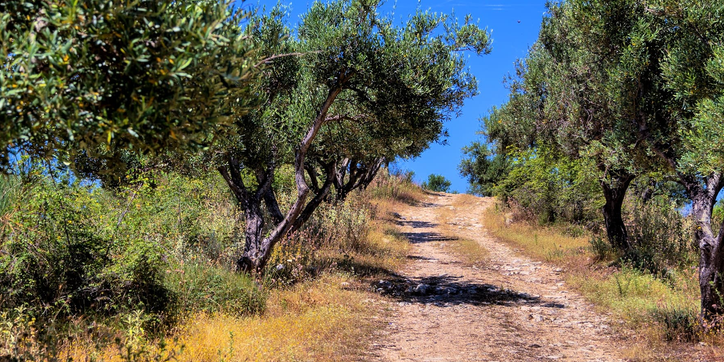
Narrow routes, slopes and plots where the size of the machine matters.
01 / Context
In many olive groves, work does not take place on flat ground with easy access.
Narrow rows, slopes, uneven routes and dispersed plots make moving harvested produce a task of its own. When larger machinery cannot fit, the burden returns to manual carrying.
REALITY / 01
A useful machine must begin with the conditions of the plot rather than an ideal scenario.
02 / Concept
Currently in development
RestoreEdge is being developed as a compact transport platform for olive groves and plots where space, slopes and access call for a smaller solution.
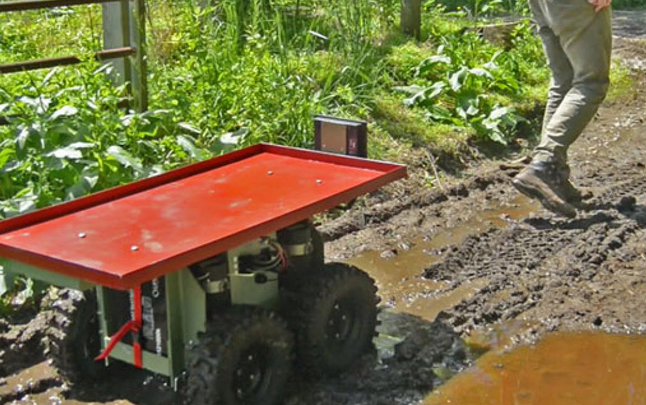
This supplied image illustrates the category of machine. It is not presented as a photograph of the RestoreEdge prototype.
The concept is being developed for narrow spaces, small plots and routes where larger machinery faces practical limits.
Remote control is being explored as part of development, with the aim of supporting more flexible work around trees and uneven terrain.
The machine aims to help move harvested produce from the plot to a collection point and reduce repeated manual carrying.
03 / Why it matters
The goal is not to add technology for effect. It is to make a specific task easier under the conditions where it is performed every day.
The goal is to reduce the need for repeated manual carrying during harvesting.
Its dimensions and architecture are being considered for small, dispersed farms with difficult access.
Future phases include field testing and repeated refinement of the concept.
Control and telemetry are being studied only where they can make work simpler and safer.
04 / Engineering work
Development work is examining the relationship between compact dimensions, stability and control. Every choice must be evaluated in a prototype and later in the field.
Solutions for the behavior of the structure on slopes and uneven ground are being studied.
One objective is an architecture that manages loads while retaining a compact form.
These functions are development directions that must be validated through the prototype and testing.
05 / Project status
OVERALL STATUS
Currently in developmentDefined
Defining transport challenges in small, sloped plots or locations with limited access.
In development
Developing the mechanical architecture, stability, suspension and weight distribution.
In development
Refining the mechanical solutions and control approach for a functional prototype.
Planned
Evaluating stability, maneuverability and use under real agricultural conditions.
Planned
Improvements based on test results and feedback from field use.
Dates, specifications and test results will only be published once confirmed. This page reflects the current direction of development, not a finished product available for sale.
06 / About the project
We are developing a tool intended to become a practical part of a farmer’s everyday work.
RestoreEdge starts with a tangible problem: moving harvested produce in places where terrain makes transport physically demanding and larger machines do not fit easily.
The approach is straightforward: develop the concept, build the prototype, test it in the field and improve it based on what is learned. Feedback from real use will form part of future stages.
07 / Questions & Answers
Direct answers about the current stage, intended use and next steps.
RestoreEdge is developing a compact motorized agricultural transport concept. The first use case described in the project materials is moving harvested produce through olive groves and plots with difficult terrain.
The concept is intended for farmers and smaller farms where plots are narrow, dispersed, sloped or difficult for larger machinery to access.
No. The product is currently in development. Information about testing, pilot use and availability will be published once those stages have been confirmed.
Current work focuses on the concept, engineering and prototype development. Field testing and the iterations that follow are planned stages.
Yes. Field testing is planned as a future phase. It will be used to evaluate the developed solutions and guide further improvements.
Stability, suspension, weight distribution, structural durability, remote control and telemetry concepts are part of the engineering work. They are not presented as completed capabilities.
Complete the contact form below and select the type of interest that best applies. Your message will be sent to the project team for a response.
08 / Contact
Are you a farmer, institution, potential partner or simply interested in the project? Tell us what brings you here.